

Ever wanted to pick the brain of one of our data pros?
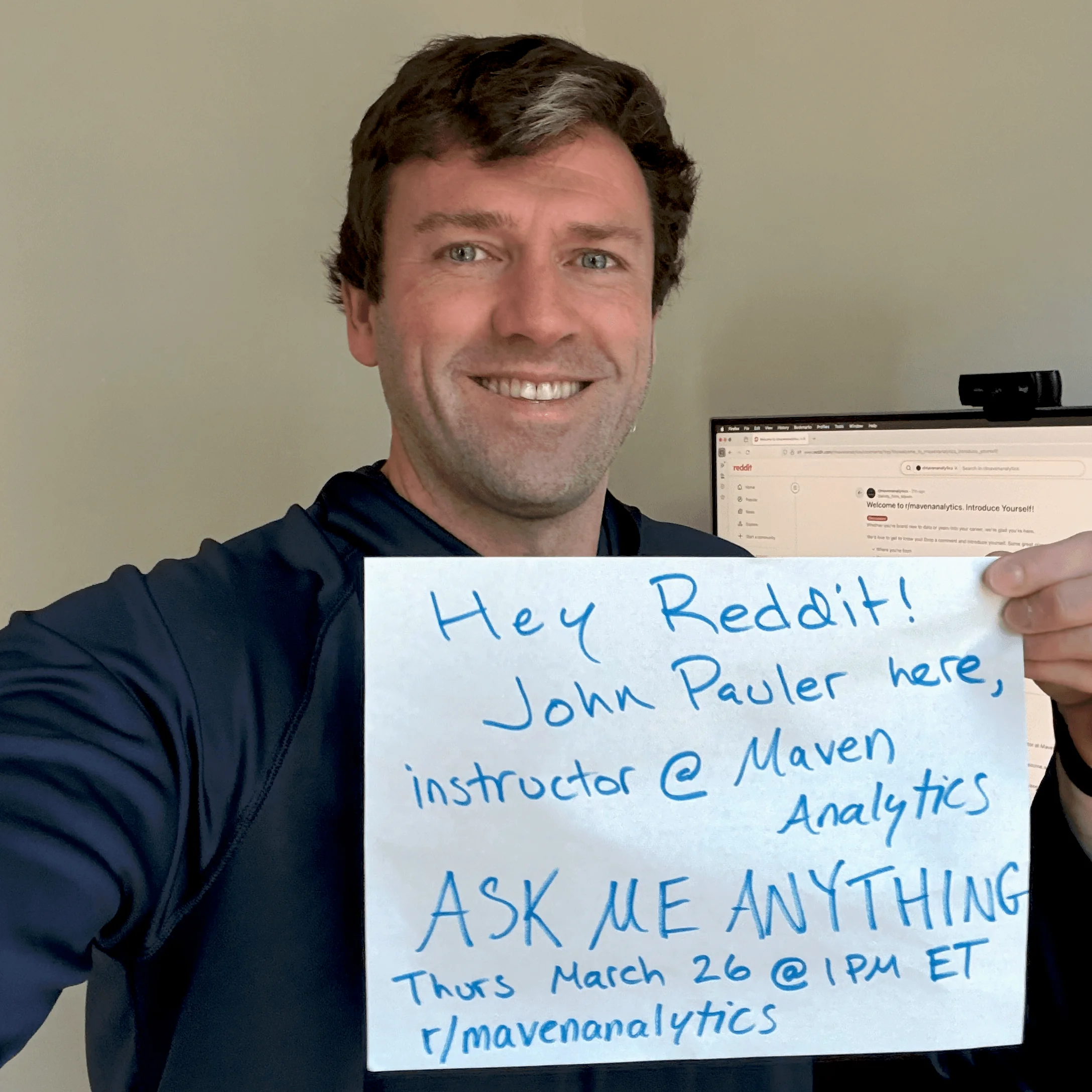
That recently became a reality thanks to our subreddit, r/mavenanalytics!
On March 26th, John took the time to sit down and answer some of the community’s most pressing questions in a Reddit Ask Me Anything (AMA).
Here are some highlights that you may have missed from the session!

In my own industry, I am seeing many layoffs as a result of cost-cutting measures, largely due to AI. How do you help stay relevant in the workforce? How do you ensure you are employable and can stay relevant, especially as a BI Analyst?
Yeah, you are struggling with the same thing that a lot of people are struggling with right now.
Biggest things… think about what AI can and can’t actually replace, and lean into the things that will remain “human differentiators”.
Critical thinking and judgement, communication with stakeholders, framing the right problems and understanding which problems to work on, being able to direct the ai and validate results…focusing here is good.
You also still need the basic foundations, or “core data skills” because without those AI is not going to solve your problems for you. With them, AI might turn into leverage.
On layoffs, etc…
Today, every CEO out there is feeling the same pressure: to not be the only CEO that fails to capitalize on this AI wave and drive efficiency.
Plus, a lot of them overhired for a few years and are going into headwinds economically right now. So, more pressure.
What a lot of people are finding, though, ( I am!) is that while AI tools are amazing at some things, they aren’t materially moving the needle in other areas. And in some areas where there might be efficiencies, it needs someone who is really good at the domain AND at using AI in a really smart way. And the gains are more marginal even in best case scenarios.
Will we find that AI makes some tasks quicker? Absolutely. But a lot of stuff we are finding doesn’t totally work, and you still need very competent people to positively impact a business.

From your experience, what skills or approaches should I focus on as an early-career professional to make that transition successful in the AI‑driven future of analytics?
The biggest thing I would focus on right now is defining your niche. The market is really tough right now, and the “generic data analyst” is not going to get traction.
So make sure there is one or two functions (marketing, finance, operations, etc) that you have an edge in, where you know a lot more than the average analyst.
And ideally, if there are one or two industries you really like, focus there too.
If you focus, you can really get your head around the business problems that hiring managers need solved (vs “I can do generic data work”). You can work on projects in these industries, too.
I think this is a must today.

Are there any skills or tools that you don’t think are worth learning anymore that were valuable a couple of years ago?
I'm not sure that I would say there are many skills that are "not worth learning" today and into the future.
You still need strong data fundamentals like data structures, the workflow of a good analysis, how to translate to business needs, validate results, and communicate with your team to drive impact. If you've got those fundamentals, AI helps you move faster with certain stuff.
So while it's still worth learning, there is some technical stuff that becomes easier... initial scaffolding of a query, data cleaning, syntax (you don't need to memorize, but between Google/SO you didn't need to before AI either).
Still super important to understand the workflow, and what the tools can do (and a basic understanding of HOW they do them), even if you can look up the specific coding syntax and get AI to take on a lot of the legwork for you. But you need to have enough of the skills to steer it.
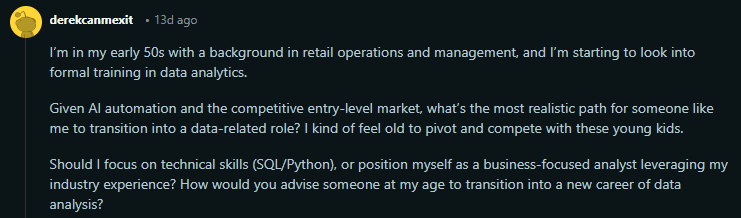
Given AI automation and the competitive entry-level market, what’s the most realistic path for someone to transition into a data-related role?
I’ve worked with plenty of folks in a similar spot as they are going through their transition.
Your edge over a lot of other analysts is going to be business acumen, and ideally industry-specific experience, which you can leverage by targeting roles where your domain knowledge is valuable.
You do also need to build the fundamental technical skills. Those haven’t gone away with AI. But if you do build the foundations, AI can give you some leverage.
Practice doing data work on real business problems. Use Excel, SQL, and then Power BI or Tableau to start. Python is cool, but it can come later. Do not start with Python unless you have a computer science background. It’s not often required in an analyst role, and while useful, it can be harder to pick up if you don’t know Excel and then SQL first.
Your aim is to find the specific roles where your personal domain experience (your edge) and the technical skills you’ll build (table stakes) will overlap to solve that business’ specific problems.

Looking back at your career since 2007, what’s the biggest pivot you made that felt risky at the time but paid off in the long run?
I can think of 2, and the common thing was they both scared the %*# out of me :)
Age 25… I was an individual contributor senior analyst. Had never managed anyone. On a small analytics team, my manager and another key contributor analyst quit within the same week. I panicked, of course, haha. Then I decided to walk into the SVP’s office and make a pitch… I would become the Manager and hire an Analyst (my first). I could start today, and they don't have anyone else lined up. They know they like me. If they find someone else they love, they can still hire them if I fail. They took my pitch, and I found out I really like mentoring people, which became a huge part of my career.
Age 28? 29?…. Being at a huge company and realizing if I got hit by a bus, the stock price wouldn’t change. That stung. Felt like my work didn’t matter, and I lost motivation. Decided to try and get a job at an early-stage startup. Best career decision ever. Much more responsibility on real things, and my work mattered for better or worse. I felt like I needed to show up strong every day and that people were counting on me, and I got to stretch in ways I never would at big companies. It’s not for everyone. Definitely more stress. But I have loved it.
Wrapping Up…
This AMA session was full of information to help you take the next step, wherever you may be in your data journey.
You can read the full AMA here, and if you’re experiencing FOMO, be sure to join us at r/mavenanalytics; we’ll have more AMA opportunities ahead!


Dakota Brown
Sr. Content Marketing Specialist