

Beginner’s Guide to Tableau Certification
Are you just starting out on your Tableau journey, or are you an experienced Tableau developer? Either way, Tableau Desktop certification can provide a number of benefits.
These benefits include:
Validation of your Tableau Desktop skills
Opportunity to promote your accomplishments
Access to new job opportunities or promotions
Feeling awesome 😊
Tableau Certification Exams
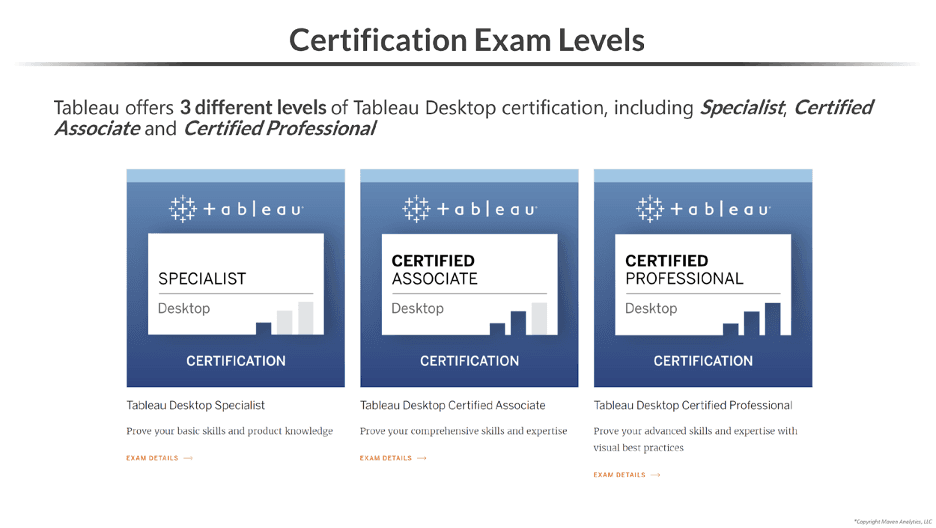
There are three different levels of Tableau Certification for Tableau Desktop, including Desktop Specialist, Certified Associate, and Certified Professional.
Each certification type has its own structure, time limit, topic set, and cost. Many developers will start with the Tableau Desktop Specialist exam, then move up through each of the certification ranks.
Exam Structure
Each certification exam has its own unique structure, including question format, time limit, and passing score. Below is a breakdown of important differences between the Tableau certification exams in terms of how they are structured:

Question Types
The types of questions found in Tableau Certification exams are split into two types: Knowledge-based and Hands-On.
Knowledge-based questions are multiple choice questions which reflect core desktop product knowledge. These questions can be related to formulas, menus, field types and more.
Hands-on Questions are multiple choice questions that require testers to actually use Tableau Desktop during the exam to find answers using provided data sets.
The Desktop Specialist and Certified associate exams will focus on these types of questions, while the Certified Professional exam involves a more hands-on dashboard building exercise.

Skills Covered
While there are many different skills covered, most major topics can be found in both the Tableau Specialist and Tableau Certified Associate exams, including:
Data Connections
Organizing & Simplifying Data
Field & Chart Types
Analytics
Calculations
Mapping
Dashboards
Since the skills tested are so similar between the Specialist and Certified Associate exams, the good news is that you can prepare for both exams simultaneously (or choose one or the other). The only significant difference in content is the quantity of questions and the level of difficulty.

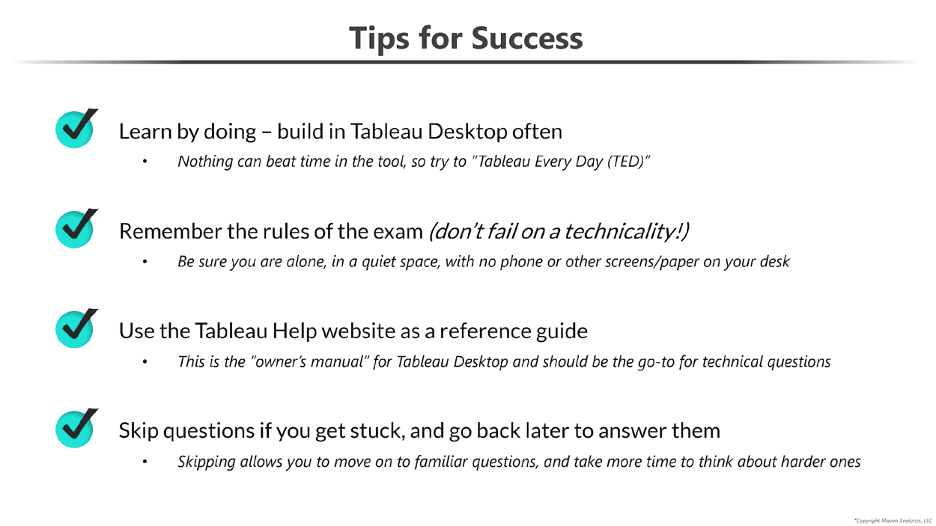
Tips for success
So, what are the most important factors to keep in mind when preparing for Tableau Certification? Here’s my go-to list that you should keep in mind before you register for your certification exam:
Now that we’ve shared a quick overview, make sure to check out our brand new certification course, designed to help you build the exact skills you need to ace your Tableau Desktop Specialist or Certified Associate exam:
Tableau Certification Prep: Desktop Specialist + Certified Associate
Thanks for reading, and good luck!
Dustin


Dustin Cabral
Lead Tableau Instructor
Dustin is a professional Tableau developer and data visualization consultant with 10+ years of experience leading analytics and BI projects. He's a featured Tableau author and currently leads the world's largest Tableau User Group.