


Sign up Pro or Login to Watch On-Demand Workshop
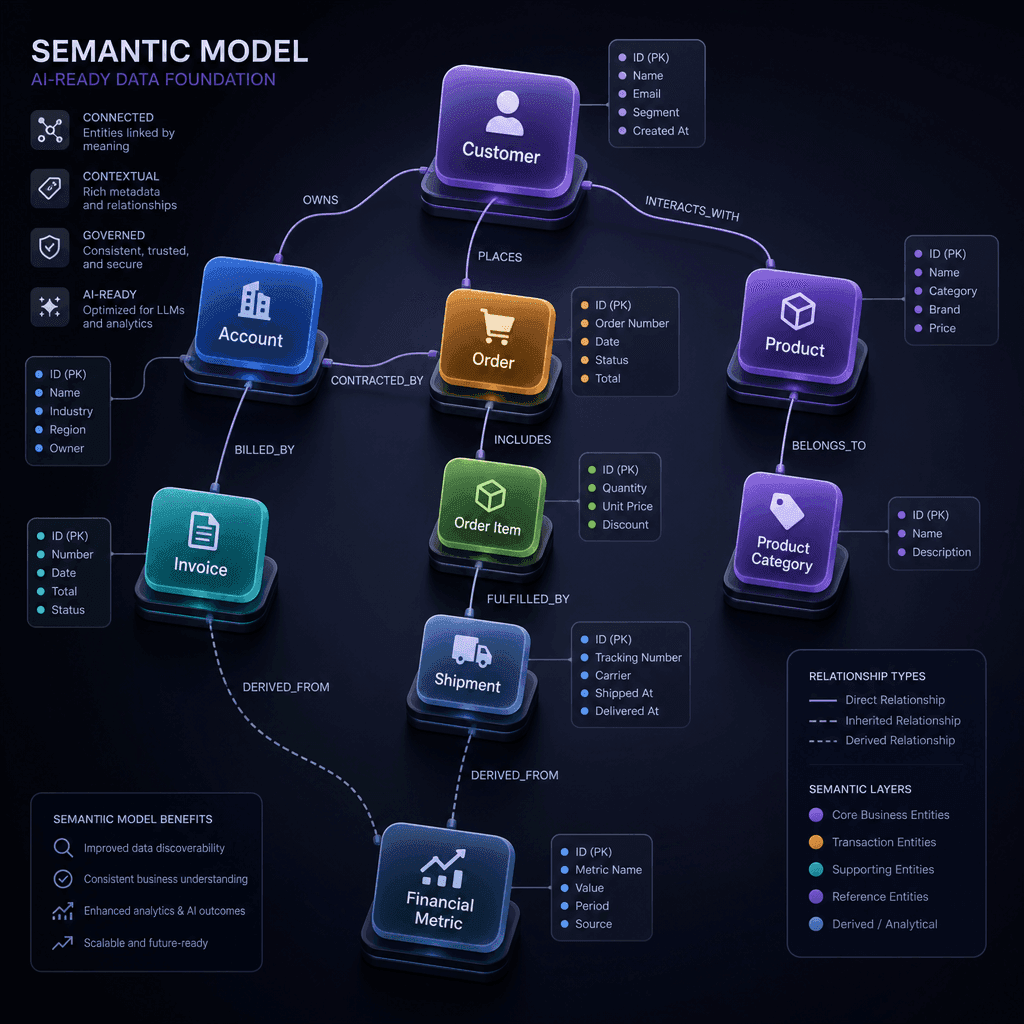
If you write SQL confidently and can run workshops with stakeholders, you've probably noticed a recurring problem: "Monthly Sales" gets redefined every time someone builds a new dashboard. Now your team wants to deploy AI for self-service analytics, and the question of whether AI can actually use your data correctly is becoming harder to dodge. Semantic modeling is how you solve both problems at once.
In this session, you'll go from A to Z on semantic modeling — where it comes from, why it matters, and how to build one. You'll start with a simple example and finish by deploying a real semantic model on your own data, ready to use and improve after the session ends.
What you'll learn
Identify the business need for a semantic layer
Most teams hit this problem before they have a name for it — this session gives you the vocabulary and the rationale to make the case internally.
Understand the technical baseline before building ontologies and taxonomies
Knowing what needs to be in place before you model prevents the most common mistakes that make semantic layers brittle or inconsistent.
Apply a semantic model to a real KPI scenario
Walk through a concrete example to see how modeling decisions translate into something a stakeholder or AI system can actually use.
Build a semantic model on your own data
You'll leave with a working artifact, not just a concept, that you can extend and put into production after the workshop.
Who should join this workshop?
Data analysts who write SQL regularly and want to stop redefining the same metrics across every dashboard they build
Analytics engineers who are preparing their data layer for AI-powered self-service and need a structured approach
Data professionals whose teams are evaluating or actively deploying AI tools and need to ensure those tools can query their data correctly
Prerequisites
Proficiency in SQL (JOINs, window functions, CTEs) is required
Access to BigQuery if you'd like to follow along (free account works, but billing info is required to activate)
Access to modeled data (star schema, event-driven, one-big-table, etc.) is helpful, but not required
Matthew Brandt
Decision Engineer
With over a decade of experience, Matthew, aka the "Decision Engineer", excels in many aspects of the data analytics spectrum. He focuses on smart decision-making, outcome measurement, and operationalizing data with strong stakeholder management, and is also a prolific content creator.